 Bahasa Indonesia
 English
 Fakultas Psikologi
Universitas Negeri Yogyakarta
Jalan Colombo No. 1
Karangmalang Sleman, Yogyakarta 55281
Indonesia
Alamat surel: humas_fp@uny.ac.id, sekretaris.dekanfp@uny.ac.id
Instagram: @psikologiuny
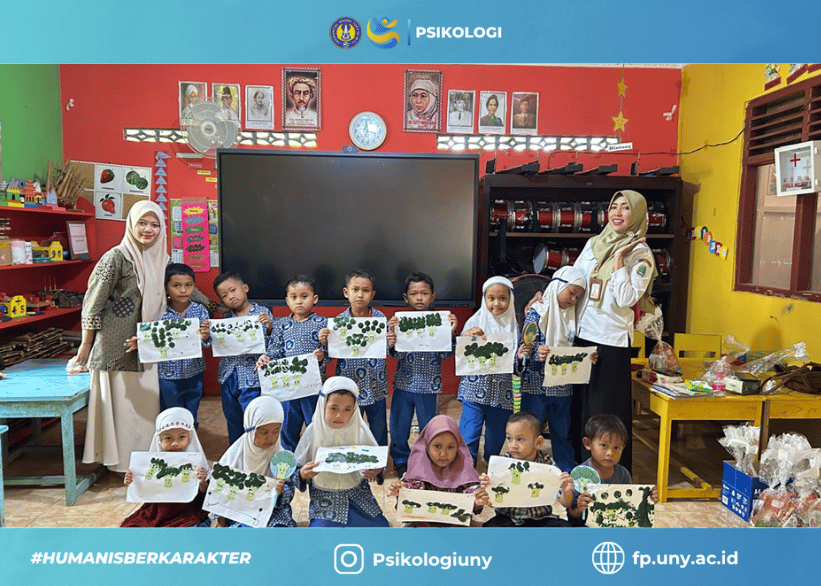
Gunungkidul, April 29, 2026 – Undergraduate and Master's students from the Faculty of Psychology, Universitas Negeri Yogyakarta (UNY), conducted an educational activity entitled "Creative Broccoli Crafts as a Medium for Introducing Emotions to Young Children" as part of the Community Engagement Program (PKM) in the Kampung Emas areas of Kepuh and Kenteng, Gunungkidul. The activity was held on Wednesday, April 29, 2026, at TK ABA Kenteng, Pacarejo Village, Semanu District, Gunungkidul Regency, involving 13 kindergarten students.
The program reflects the Faculty of Psychology's commitment to supporting early childhood social and emotional development through creative, interactive, and child-centered learning approaches. By combining storytelling, art activities, and emotional literacy, the program aimed to help children recognize, understand, and appropriately express their emotions in an enjoyable learning environment.
The activity began with an introductory session between the facilitators and the children. The facilitators, who were undergraduate and graduate psychology students from UNY, introduced various emotions using illustrated broccoli cartoon characters displaying different facial expressions, including happiness, sadness, embarrassment, disgust, surprise, fear, and anger. Through interactive storytelling and simple discussions, children were encouraged to identify each emotion and relate it to their own daily experiences.
In addition to emotional literacy, the facilitators introduced broccoli as a nutritious vegetable and explained its health benefits in language appropriate for young children. This integrated approach enabled participants to learn about both emotional well-being and healthy eating habits within a single educational activity.
The program continued with a Creative Broccoli Craft session. Participants were divided into four groups, and each child received broccoli stem templates, decorative beads for the eyes, and craft materials. Children assembled the broccoli figures, created colorful broccoli heads using bottle-cap printing techniques, and drew facial expressions representing the emotions they had learned during the introductory session.
Beyond developing fine motor skills and hand-eye coordination, the creative activity encouraged children to recall, differentiate, and express various emotions through artistic expression. This play-based learning approach created an engaging environment that supported both cognitive and socio-emotional development.
At the end of the activity, each participant presented their artwork to classmates and facilitators while explaining the emotion represented in their broccoli character and describing situations in which they might experience that feeling. This presentation session fostered children's confidence in public speaking, strengthened their communication skills, and encouraged healthy emotional expression from an early age.
The Creative Broccoli Crafts for Emotional Literacy program was successfully implemented and received positive feedback from both students and teachers. Through creative and enjoyable learning experiences, participants demonstrated a better understanding of basic emotions and greater confidence in expressing their feelings. The activity is expected to provide a strong foundation for children's emotional intelligence, which plays an essential role in their future learning, social relationships, and psychological well-being.
This initiative also reflects the Faculty of Psychology's commitment to the Tri Dharma of Higher Education, particularly community engagement, by applying psychological knowledge to promote children's healthy development while providing meaningful experiential learning opportunities for university students.
The program also contributes to the achievement of the United Nations Sustainable Development Goals (SDGs), particularly SDG 3 (Good Health and Well-being) by promoting children's mental health and socio-emotional development, SDG 4 (Quality Education) by providing creative and inclusive early childhood learning experiences, and SDG 17 (Partnerships for the Goals) through collaboration between higher education institutions and early childhood education providers to improve children's learning and well-being.

 Fakultas Psikologi