 Bahasa Indonesia
 English
Master’s Psychology Public Lecture Explores Emerging Issues and Future Directions in Positive Psychology Research
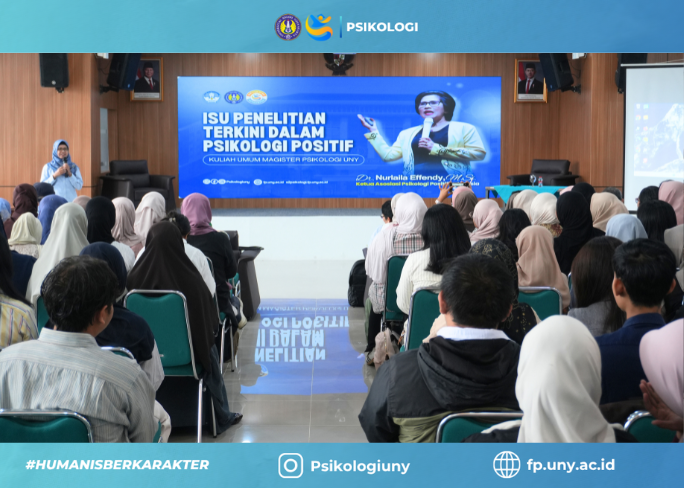
YOGYAKARTA — The Faculty of Psychology, Universitas Negeri Yogyakarta (UNY), successfully held a public lecture for Master’s Psychology students entitled “Research Issues in Positive Psychology 2026” on Tuesday, 8 September 2026. Held at the 7th-Floor Auditorium of the New Faculty of Psychology Building, the academic event provided a forum for students and members of the academic community to explore emerging issues, current developments, and future directions in positive psychology research.
The lecture featured Dr. Nurlaila Effendy, M.Si., Chair of the Indonesian Positive Psychology Association, as the keynote speaker. In her presentation, Dr. Nurlaila provided a comprehensive overview of the current landscape of positive psychology research and encouraged participants to examine how the field continues to evolve alongside technological developments, changing individual needs, and the dynamics of contemporary social and professional environments.
Positive psychology is no longer limited to the study of happiness or pleasant psychological experiences. Its development increasingly encompasses broader questions concerning human strengths, meaning, well-being, and the capacity of individuals to thrive across different contexts of life.
Exploring Technology and Artificial Intelligence in Psychology
One of the key topics discussed during the lecture was the growing role of Artificial Intelligence (AI) in psychology, particularly its potential application in coaching practices. Advances in technology are opening new opportunities to support individual development, including through personalized feedback and the use of data to better understand individual needs and experiences.
At the same time, the integration of AI into psychological practice raises important questions about how technology can be used responsibly while maintaining the human-centered nature of psychological services. This perspective is particularly relevant for Master’s Psychology students as they prepare to engage with emerging technologies while continuing to consider ethical principles, contextual factors, and fundamental human needs.
The discussion also highlighted personal narratives as an approach to understanding how individuals interpret and give meaning to their experiences. Personal narratives provide opportunities for researchers to explore how people make sense of their life experiences, construct meaning, and develop perspectives about themselves and their surrounding environments.
This approach demonstrates that positive psychology research can extend beyond quantitative measurement to include deeper explorations of subjective human experiences and the meanings individuals attach to their lives.
Positive Psychology in Industrial and Organizational Settings
The discussion was further extended to the industrial and organizational context. As workplaces continue to experience significant changes, employee well-being has become an important consideration in both the quality of working life and organizational sustainability.
Positive psychology research in industrial and organizational settings can address a range of issues, including workplace well-being, individual strengths, work engagement, meaning at work, and the conditions that enable both individuals and organizations to grow sustainably.
Such perspectives provide opportunities for Master’s Psychology students to develop research that goes beyond understanding individual psychological conditions and examines how psychological knowledge can contribute to addressing real-world challenges in the workplace.
The discussion became even more interdisciplinary when positive psychology was connected with neuropsychology. This perspective provides opportunities to understand positive psychological experiences not only at the behavioral and subjective levels but also through the biological foundations and neural mechanisms underlying these experiences.
The intersection of positive psychology, neuropsychology, technology, and industrial and organizational psychology demonstrates the growing potential for interdisciplinary research. It encourages researchers to examine psychological phenomena across multiple levels, ranging from personal experiences and behavior to biological mechanisms and organizational contexts.
Strengthening Research Perspectives in Master’s Psychology
The public lecture was part of the Faculty of Psychology UNY’s efforts to enrich the academic experiences of Master’s Psychology students. Exposure to contemporary research issues provides students with opportunities to identify emerging developments in the field while exploring potential research topics that are relevant to current societal needs.
At the master’s level, the ability to develop research that is contextual, evidence-based, and practically relevant is an important component of academic development. Discussions on contemporary issues in positive psychology can therefore encourage students to develop critical perspectives and strengthen the connection between psychological theories and real-world challenges.
More broadly, the integration of psychology with technology, neuropsychology, and industrial and organizational contexts highlights the importance of interdisciplinary approaches in addressing complex human issues. Positive psychology research can serve as a platform for generating knowledge that not only contributes to the development of psychological science but also supports efforts to improve individual and community well-being.
Contributing to the Sustainable Development Goals
The public lecture also relates to several Sustainable Development Goals (SDGs). In terms of academic development and research capacity, the activity supports SDG 4: Quality Education, particularly through the development of academic competencies, lifelong learning, and students’ exposure to contemporary developments in science, research, and technology.
The discussion of psychological well-being and positive human experiences is also closely connected to SDG 3: Good Health and Well-being. Positive psychology research can contribute to a better understanding of factors that support psychological well-being and quality of life at both individual and collective levels.
Meanwhile, the exploration of positive psychology within industrial and organizational settings is relevant to SDG 8: Decent Work and Economic Growth, particularly through its attention to employee well-being, quality of working life, and psychological conditions that can support healthy and productive workplaces.
These connections demonstrate that postgraduate education in psychology is not solely concerned with mastering theories and research methodologies. It also seeks to develop knowledge that responds to broader societal challenges and contributes to sustainable development.
Through the “Research Issues in Positive Psychology 2026” public lecture, the Faculty of Psychology UNY continues to foster an academic environment that connects developments in psychological science with real-world needs. The integration of positive psychology, artificial intelligence, personal narratives, neuropsychology, and industrial and organizational dynamics illustrates how future psychological research can benefit from increasingly open, contextual, and interdisciplinary perspectives.
The Faculty of Psychology UNY extends its appreciation to Dr. Nurlaila Effendy, M.Si., for sharing her expertise and insights, as well as to all students and members of the academic community who actively participated in creating an engaging and meaningful academic discussion.




Contact Us

Faculty of Psychology
Yogyakarta State University
Colombo Street Number 1
Karangmalang, Sleman, Yogyakarta 55281
Indonesia
Email: humas_fp@uny.ac.id, sekretaris.dekanfp@uny.ac.id
Instagram: @psikologiuny